
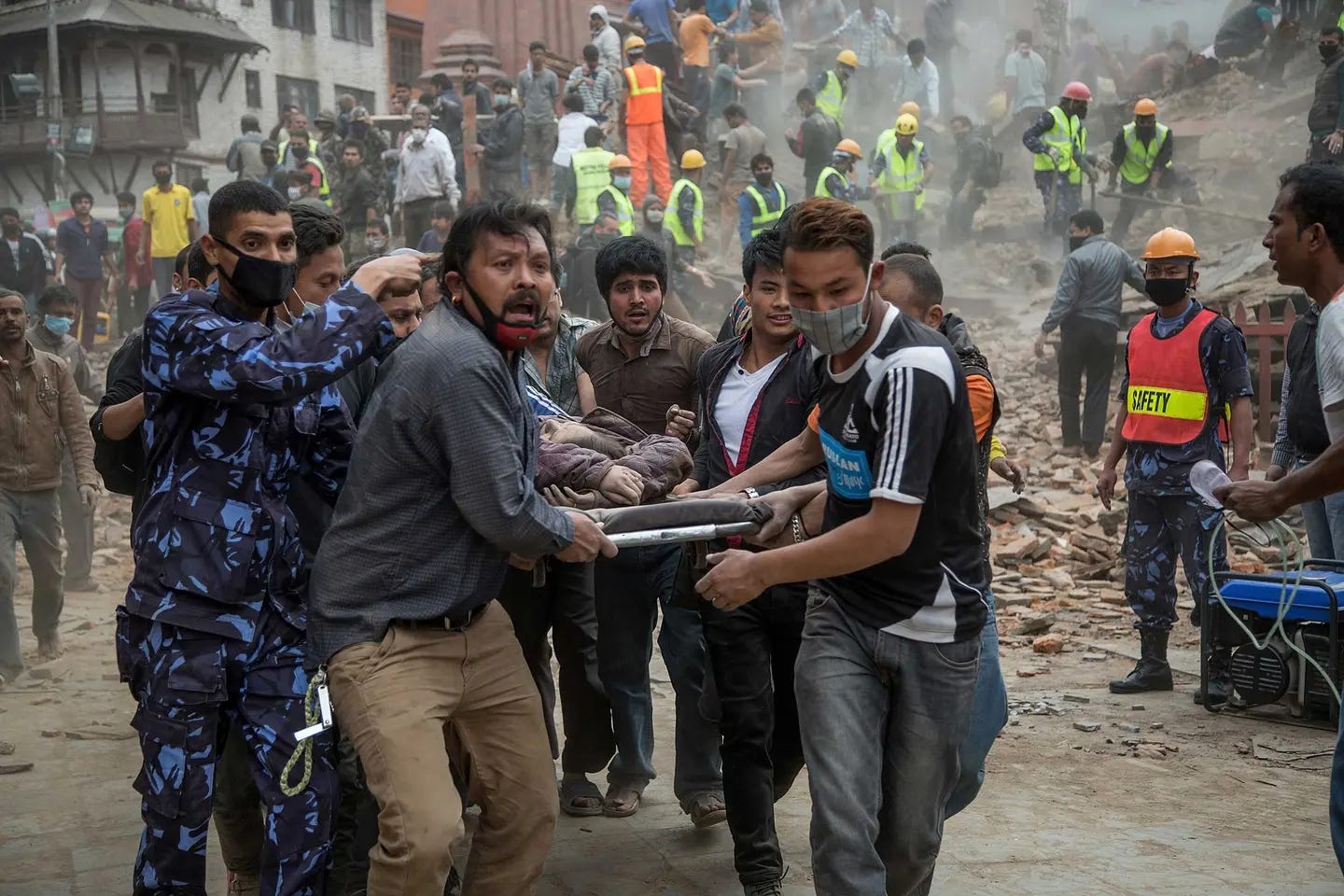
A few years ago I wrote this essay, the shattering news of lost pilgrims in Nepal and Tibet reminded me of this piece…
“Only god could help me now...It was a natural disaster and god’s will. I think of it as a train journey where everyone chats through the journey, but has to get down when the station arrives. Maybe Kedarnath was my wife’s final station…I now spend my time meditating and chanting god’s name to distract myself. If you ask me whether I would go to Kedarnath again, the answer would be an emphatic yes..”
The above reflections are of a particular pilgrim, Ram Karan Beniwal, who barely survived the devastating floods and landslides in Uttarakhand in 2013, in which thousands were swept away and many bodies never recovered. The destination of Beniwal, his wife, two brothers, and their wives was Kedarnath, a very important site of Hindu pilgrimage.
I remember the discussions of this incident in 2013 when my grandfather was reading the newspaper and my brother who was 16 years old questioned Ram Karan Beniwal’s hypocritical stance on thanking god despite his loss. To this my grandfather replied “God is the creator and the destroyer. It is about maintaining faith in his plan, despite not understanding his ways”. To this my brother confronted him by asking “But why keep faith in a God that allows suffering?”. My grandfather, a philosophy enthusiast, said “Faith sees best in the dark,”.
This saying by Søren Kierkegaard recounted by my grandfather means true faith is tested when it meets with uncertainty and suffering. Looking for God and thanking him in adverse conditions is a testament to our faith. It is a form of gratitude symbolizing belief in divine intervention. The act of thanking God according to the Cambridge dictionary is defined as “something you say when you are happy because something bad did not happen”. But, to thank God, it is key to understand the essay’s stance on the idea of God. With a lineage of devout believers of God, the exploration of this theme of theology will be conducted from a theist’s perspective. This distinction is essential, because the lens of interpretation will influence the conclusions drawn and explorations made. This lens will assist in exploring the highly subjective and relative question whether it is reasonable to thank God for protection from some natural harm if He is responsible for causing the harm. In this essay, I understand ‘natural harm’ as solely “natural evil” defined by Saint Augustine as suffering that isn’t directly linked with human intervention such as disease, congenital disorders, death, earthquakes, tsunami, volcanic eruption, flood and storms. In the occurrence of such natural evil, spiritual and religious prayers, rituals, and acts of worship are conducted to acknowledge a God’s benevolence. However, it is also questioned that natural harm stems from God; and this paradox raises the question of whether it is reasonable to thank God under such circumstances. It is a complicated question, however, thanking God is reasonable only to the extent where it does not diminish the responsibility of an individual for their actions affiliated with the harm or protection. This, nonetheless, requires understanding the fundamentals of various beliefs, God’s plan, the root of natural evil, the role of natural harm, relativity of suffering, origin of harm and protection and the responsibility of God in these situations to arrive at this intersection of faith, protection, and suffering.
To illustrate this point, Job’s example from the Bible is perhaps one of the best. In a series of four events, Job’s wealth (material and offsprings) and health are lost as a result of Satan trying to prove a point with God. Job, as a representative of innocent suffering, poses a rhetorical question “Shall we receive good at the hand of God, and shall we not receive evil? (2:10)” after his wife tells him to “Curse God and die” as a response to the agony they were suffering. The loss of their sons and daughters, the fire that wrecked his cattle and Job being burdened with physical affiliations made it challenging for his wife to sustain her faith. But Job’s remarks indicate that good and evil / protection and harm are all essential components of God’s domain. Even though Job becomes bitter towards the end of the book condemning God twice, his faith in God is restored in a personal dialogue with Him. In the end Job’s fortunes and faith are restored in perfect harmony with the living God.
This line of belief that it is reasonable to thank God for protection from … seems to run in Aquinas’ thought, “since God is the highest good, He would not allow any evil to exist in His works, unless His omnipotence and goodness were such as to bring good even out of evil”(Enchiridion xi). This statement showcases that as God, an omnipotent, omniscient, and omnibenevolent being can never harm humans without reasonability. Harm is a direct part of God’s superior plan that is unimaginable to humanity as it extends our immediate circumstances. It is a “leap of faith” as said by Kierkegaard one must perform where we put our trust in God despite the epistemic distance and lack of empirical reasoning and believe that even suffering has a justified unknowable cause
Although the reason for the harm inflicted may be unknown, its outcome can be considered beneficial, and value driven. The concept of karma that derives from Hindu theology gives systematic answers towards the cause of harm. Karma refers to the force that determines a person’s destiny after reincarnation based on the individual’s actions. This perpetuates the idea that everyone is solely responsible for the harm they suffer as it is a direct consequence of their prior wrongdoings. In Vedic scriptures there are three types of suffering, one of them is adhidaivika which is natural harm caused by demigods such as famine, earthquakes, and floods. When an entity (living beings) becomes astray of their dharma (divine duty) they are bound to witness its negative consequences. Misuse of our free will is the root cause of our own suffering, therefore the harm one suffers is not caused only by God. This can be observed, as today’s natural calamities are direct reciprocations of our disregard for natural equilibrium and unethical practices. One can argue that because of a lack of duty towards our environment, we suffer the consequences of global catastrophes such as climate change such as displacement, poverty, health crisis and loss of lives. This would then certainly seem to help understand the unexpected disastrous landslides and floods of 2013.
According to John Hicks “soul-making theodicy” focuses on not looking in the past to uncover the discovery for suffering rather the future. Hick believes suffering construct virtues and are trials that pave the pathways towards spiritual development. Furthermore, author Viktor Frankl (holocaust survivor) in his logotheraphic novel Man Searching For Meaning makes a similar argument about how individuals can find purpose in the face of suffering. Throughout the novel, he observed that those who had to undergo concentration camps were able to strengthen their familiar bonds, reassess priorities and live a more fruitful life. Does this then mean that we feel happiness because sorrow exists, bravery because we have dealt with fear and a purpose of life when we confront suffering? Similarly, survivors or “the protected” from natural harm draw to spirituality to deal with the aftermath of disasters or tragedies, in the form of gratitude. Frankl insight suggests, thanking God amidst suffering is not denial of inconsideration of the pain inflicted rather an opportunity of redemption, growth, and meaningful experiences.
Subsequently, many people believe that in religious preaching Good and Evil originate from separate deities. Such as the duality of Devas (good celestial beings) and Asuras (evil celestial beings) in Hinduism and God and Lucifer, two contrasting forces in Christianity. When the source of evil and harm is not God, rather is of separate origin, why does one still blame God for harm and feel it contradictory to display gratitude for its protection? This is explained by philosophy professor Jordan Peterson in lecture “Is God Really Perfect or is Evil a Separate Entity” who explains that even though it seems God and Devil are separate, they are one. He explains how Lucifer, the embodiment of evil in Christianity is an outgrowth of God. In Milton’s “Paradise Lost’‘ Lucifer is a fallen angel who rebelled against God. Once the embodiment of God, went astray. Similarly, according to Hindu mythology Puranas, the Asuras merge into God. Such as when demon Ravana in the epic “Ramayana ‘’ merges into Lord Rama after his ceremonious defeat. This explains that both “good” - protection and “evil” - harm originate from God. Just like; darkness does not have a definitive existence or substance, other than its correlation to lack of light. Likewise, evil is just the lack of goodness.
This lack of goodness is an essential concept of God’s design. In John Hick, ‘An Irenaean Theodicy’ he believes natural evil exists because of “fall of grace” where angels and humans rebelled against God, corrupting the physical world to suffering. An individual’s pursuit of free will has resulted in disruption of goodness. This is evident by the actions of Adam and Eve as they disobeyed God by eating the forbidden fruit of knowledge from the tree of Good and Evil, which forced a punishment to their descendants of co-existing with harm. Henceforth, even though suffering is a component of God’s design and originates from Him, it is human actions that exacerbate this suffering. One can argue that even though the 2013 Kedarnath floods were caused by God, an individual’s actions in the fallen world can determine whether they are protected or harmed. Revisiting Ram Karan Beniwal’s tragic incident he shared “I ran and stood by a large boulder, which protected me from the avalanche of rocks coming from the top.” that protected him from natural harm. This demonstrates that it is not just divine intervention, but human agency that determines the outcome of such dire circumstances.
Ultimately, while this essay considers God as the creator of suffering (harm) and relief (protection) it is still reasonable to thank God. The presence of natural evil and suffering is ingrained in His divine plan, as it is a tool that allows humanity to exercise its free will and development of moral values. By permitting such adversities, God provides scope to develop virtues and evaluate one’s choices. Thus, when God intervenes to protect or save individuals from specific instances of natural harm, it can be seen as an opportunity to maintain faith in His order. However, it is also essential to understand that it isn’t just God’s design but an individual’s use and misuse of free will to some extent determines the result of natural harm. Human agency and Divine intervention are interconnected in shaping the outcome of natural evil.
The thing with good and evil, God and Devil, is that unless you experience it personally, it’s all conjecture. From whatever little ‘experience’ I’ve had, I don’t doubt God, and I don’t claim to always thank Him either. Sometimes, the core question is whether one’s faith is rooted in helplessness and need, or genuine experience of inner knowing and bliss.
Some questions lead to more questions than closure, don’t they?